Energy and Climate Change (EC)
King Mongkut’s Institute of Technology Ladkrabang (KMITL) has implemented multiple initiatives to promote the use of energy-efficient appliances across campus facilities, supporting its commitment to sustainability and reducing energy consumption.
- Energy-efficient air conditioners:
KMITL developed a prototype inverter air conditioner system that reduces energy consumption by up to 50% compared to conventional air conditioners. Additionally, this system can feed excess electricity back into the grid, further optimizing energy use. - LED lighting upgrade:
The university replaced traditional lighting with LED bulbs across campus buildings, resulting in an annual energy saving of approximately 46.05 toe and reducing electricity costs by around 2.14 million THB per year. - Smart Energy Management System (EMS):
KMITL implemented an EMS to monitor and optimize electrical appliance usage, reducing unnecessary power consumption and improving overall energy efficiency.King Mongkut’s Institute of Technology Ladkrabang (KMITL) signed a memorandum of understanding with Beam Mobility (Thailand) Company Limited regarding electric scooter services as a travel option. For KMITL personnel and students, KMITL provides electric scooters. to be used as a vehicle To encourage environmental concern, reduce pollution, and meet usage needs. With a modern borrowing-returning system through the application 24 hours a day, creating convenience, flexibility, and creating a good quality of life. Ready to aim to be a sustainable green university.
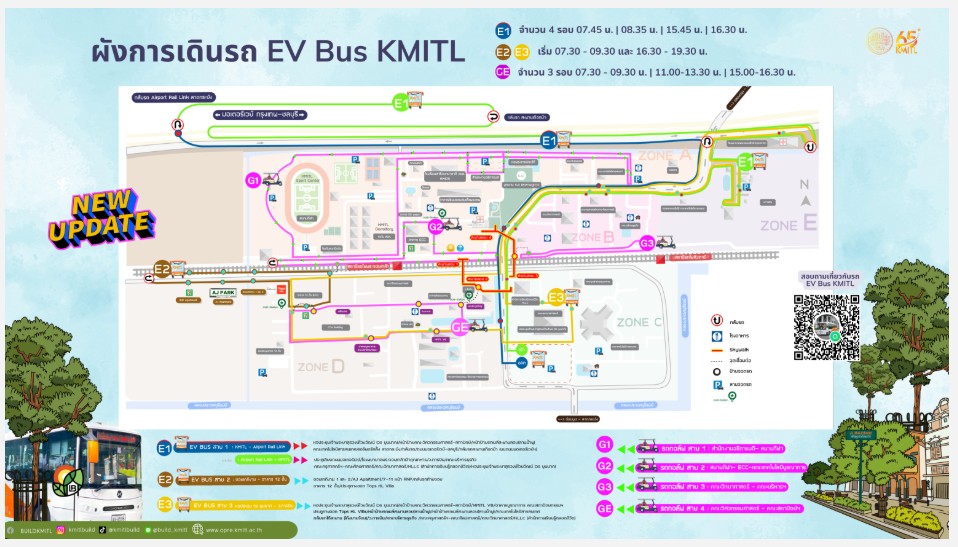
King Mongkut’s Institute of Technology Ladkrabang (KMITL) has opened a trial of electric electric bus service or EV BUS as a welfare benefit. and facilitate for students and personnel of KMITL and also helps reduce pollution. Protect the environment The EV BUS has a capacity of 20 -27 seats, providing service on the travel connection route between KMITL and the Airport Rail Link Lat Krabang station. In the EV BUS The goal is to become a Green
University by using electric vehicle technology. Reduce the use of fuel energy and reduce pollution in the institution. To achieve sustainability.
The State Railway of Thailand (SRT) has joined forces with King Mongkut’s Institute of Technology Ladkrabang (KMITL) to establish a joint working group under a memorandum of understanding on the development of rail transportation technology. Regarding the wheeled locomotive to develop into an electric system. To study, research and develop Thailand’s EV on Train, which has a project to study and develop a prototype EV Shuttle Train that will connect to the Airport Rail Link (ARL) Lat Krabang Station to KMITL Station and Hua Takhe can reduce car emission too.
The institute organizes projects/activities to help reduce carbon emissions, targeting Scope 1-3 reductions. This includes reducing fuel consumption (Scope 1), electricity consumption (Scope 2), and waste generation (Scope 3). These projects/activities can be divided into two types: those that have already been implemented and are currently ongoing, and those that are currently under development for future implementation.
Details are as follows: 1.Projects/Activities that Have Been Implemented and Are Currently Ongoing, which help reduce carbon emissions in Scope 1 and 3 as follows: 1.1 Projects/Activities that Reduce Fuel Consumption comprise a total of 2 projects/activities, namely.
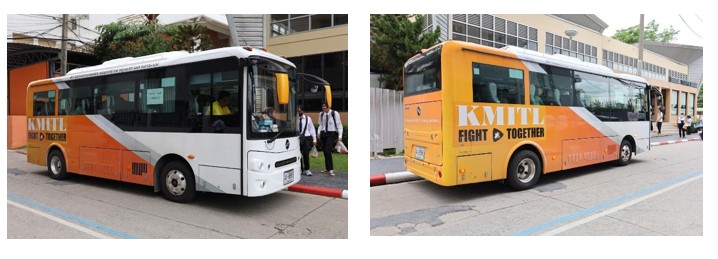
KMITL Mini EV Bus Project This project involves service vehicles used for transporting students and personnel within the institute. The service has transitioned from fuel-powered (gasoline) vehicles to electric-powered vehicles. Currently, there are a total of 3 buses providing service on two routes: KMITL – Airport Rail Link Lat Krabang and KMITL – Soi Kakee Ngam.
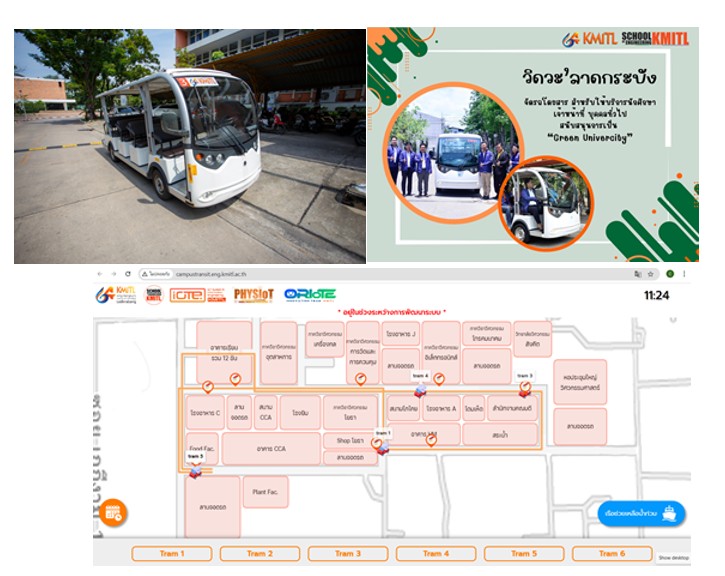
The Faculty of Engineering’s Tram Cars Project is a service vehicle project for transporting students and personnel of the institute who wish to travel within the Faculty of Engineering area. It uses 5 golf carts for this service, operating during three periods: 8:30 AM – 10:30 AM, 11:30 AM – 1:30 PM, and 3:00 PM – 4:30 PM.
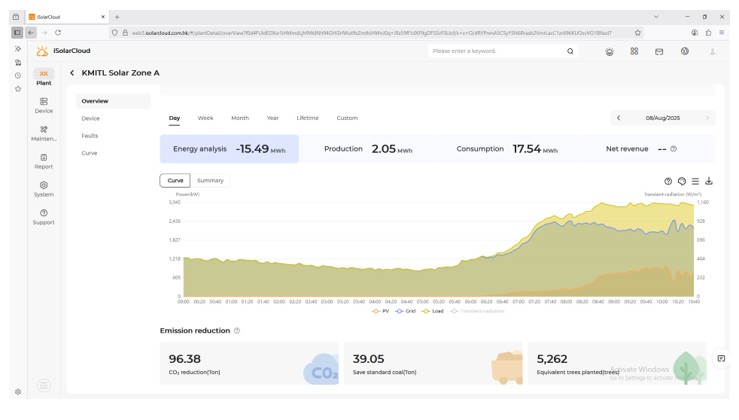
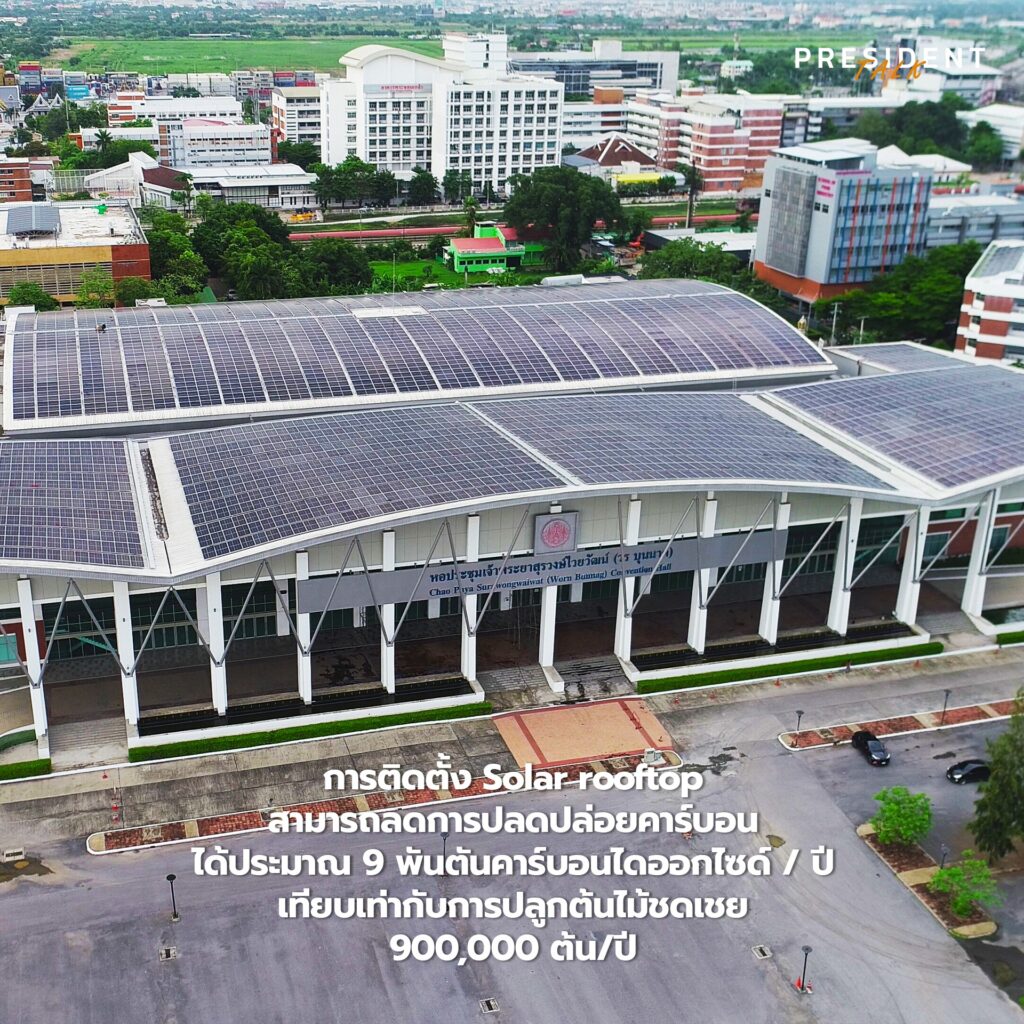
KMITL has installed a total of 1,124 solar panels across various buildings and facilities. These panels are primarily mounted on rooftops of academic buildings and administrative facilities to take advantage of direct sunlight throughout the day. The solar PV systems help generate a total of approximately 163,590.34 kilowatt–hours (kWh) of electricity per year, which averages around 13,632.53 kWh per month. This electricity is used to power lighting, air conditioning systems, laboratories, and other essential functions across the campus